⚠️ Spoiler Alert: This article contains major spoilers for Don’t Log Off. Proceed at your own risk. We’re about to unmute the chaos, open the wrong tab and watch the pixels scream.
There’s something deeply creepy about video calls. The frozen screens, the awkward silences, the flickering lights behind someone’s shoulder, they’ve all got horror movie potential. Don’t Log Off takes the paranoia, cranks it to eleven and leaves you staring at your own webcam wondering if someone’s watching back.
What starts as a harmless lockdown birthday party on Zoom turns into a claustrophobic online nightmare. The film keeps you glued to the screen, balancing found-footage realism with raw panic. And by the time you reach the Don’t Log Off ending, you’re left questioning who’s alive, who’s lying and whether logging off would have been the smarter choice all along.
If you thought horror over Wi-Fi couldn’t be terrifying, think again!
The Virtual Party That Went to Hell
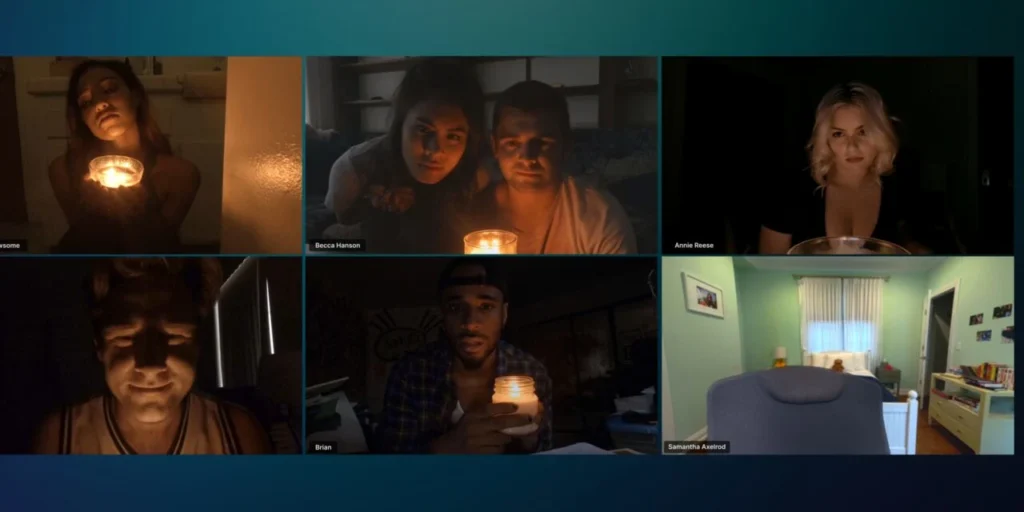
The ending of Don’t Log Off makes perfect, twisted sense once you trace the breadcrumbs from the start. It all begins with Sam’s seemingly normal birthday celebration. You know, a cheerful Zoom call during the lockdown period. Bellows, awkward toasts and poor Wi-Fi jokes. But the moment Sam leaves to answer the delivery, the vibe curdles.
Minutes turn into panic. Her friends Katy, Becca, Jacob, Brian and Adam, do what any good group chat would, they start snooping. Brian, the tech-savvy member of the crew, digs into the audio files of their recorded call and finds something chilling. He hears muffled sounds, heavy breathing and the background noise that doesn’t belong. It’s not just Sam disappearing; it’s the sound of her being taken.
And this is where Don’t Log Off cleverly evolves from screen horror into a digital detective thriller. Each friend decided to “just check in” at Sam’s apartment, breaking quarantine rules in the process. Bad idea, obviously. One by one, their webcam flickers, their phones drop and the call fills with distorted screams. It’s modern horror brilliance, your Wi-Fi becomes the monster’s hunting ground.
The Killer in the Feed
By the time only Katy is left, the Don’t Log Off ending tightens its grip. Every viewer’s instinct screams, “Just hang up!” But she doesn’t. She stays because of course she does.
The movie drops its biggest reveal: the abductor is Evan, a shadow from Sam’s past. Not a random serial killer, but someone who once knew her well. It’s a chillingly personal twist. One that makes every previous glitch and clique click into place.
Evan has orchestrated the entire abduction as a revenge-driven game. Every time a friend tries to play the hero, he’s there waiting. The idea isn’t just to kill; it’s to terrify, manipulate and make Sam watch. The video call isn’t just a witness, it’s his stage.
When Katy finally decides to comfort him in person, the movie breaks its own format. The once static, claustrophobic laptop screen gives way to handheld chaos. It’s disorienting, bloody and deliberate. You feel like the film itself has “logged off” the virtual setup, because now it’s real.
The Final Struggle
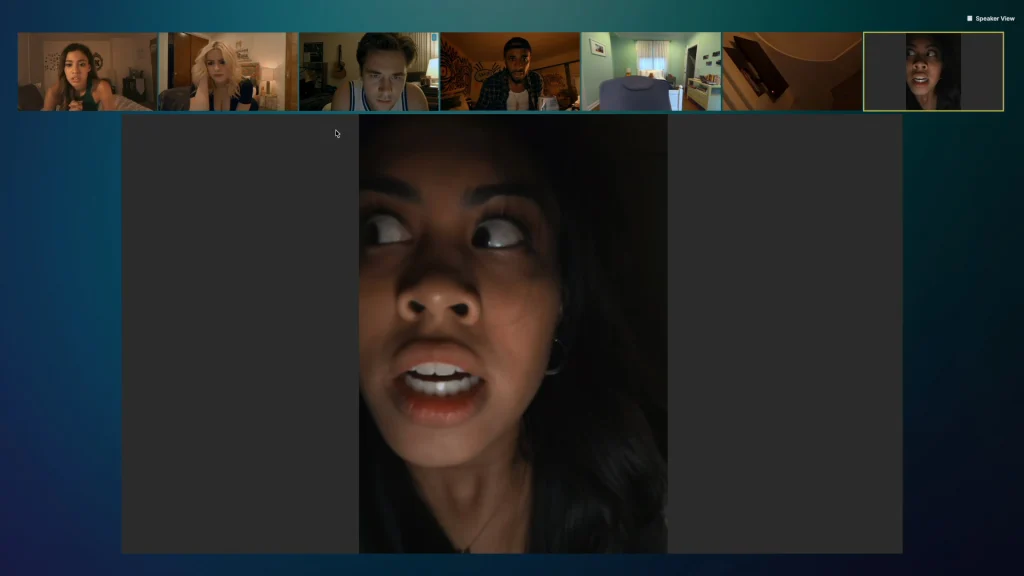
In the climax, Katy finds Sam alive, barely, along with some of the others still restrained. What follows is pure panic and chaos: dim lights, shaky breathing and the metallic echo of footsteps. The showdown between Katy and Evan is messy, raw and exactly what a story like this deserves.
There’s no heroic speech, no Hollywood-style rescue. Just a frantic scuffle, a dropped phone and a weapon changing hands. Sam, bloodied but defiant, finally turns the tables. She kills Evan with his own weapon.
For a few seconds, it feels like victory. The girls breathe, the screen stabilizes and daylight starts to creep through the windows. But the Don’t Log Off ending doesn’t let you have that relief at all. The camera cuts away just as sirens wail in the distance. There’s no confirmation of who made it out, only the echo of the video call ringtone still looping somewhere off-screen.
Also, read Hell House LLC: Lineage Ending Explained – Haunting That Never Ends!
The Ambiguity That Haunts You
The genius of the Don’t Log Off ending is that it refuses to explain everything. Evan’s motive? Hinted at, but never fully laid bare. Revenge, obsession, control, it’s all there in fragments. The ambiguity makes him scarier. He’s not supernatural; he’s just human enough to feel real.
And what about the others? We never see definitive proof that Becca, Jacob, Brian or Adam survive. Their feeds go dark and that’s all we get. The final scene cuts to black right after Sam and Katy’s fight with Evan, suggesting they’ve won, but at what cost?
Some fans theorize the survivors are rescued off-screen, while others think the video call footage itself is what we’re watching, evidence pieced together later. Either way, the Don’t Log Off ending nails that modern horror sweet spot: it doesn’t close the window, it just leaves it flickering in the corner of your screen.
Why The Ending of Don’t Log Off Works So Well
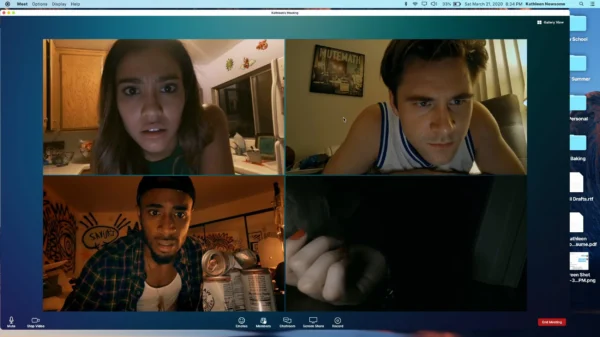
Unlike typical slasher flicks, Don’t Log Off ending thrives on digital dread, the fear of being watched when you think you’re alone. The film’s tension builds not through gore but through helplessness. You can see your friends, but you can’t reach them. You can watch someone vanish, but you can’t stop it.
Don’t Log Off capitalizes on this helplessness perfectly. It’s not about defeating the villain, it’s about realizing that connection itself has become the weapon. The video call, meant to unite friends in isolation, turns into the traps that destroy them.
There’s also a sly meta layer: the audience is complicit. We’re the silent participant on that Zoom call, watching everything unfold, refusing to look away. By the end, when the screen cuts to black, it almost feels like we should’ve logged off too.
Also, read Cobweb Ending Explained: What Lurks Behind the Wall
Conclusion: Fear, Friendship, and Frozen Screens
The ending of Don’t Log Off sticks because it captures a kind of horror that’s uniquely modern. It’s not about monsters in closets, it’s about monsters behind the camera. Every glitch, every pixelated scream, every lost connection adds to that creeping realization that technology doesn’t just connect us, it exposes us.
Sam and Katy’s final act of defiance gives the story a flicker of hope, but not safety. The internet never forgets. And that last looping ringtone? It’s not just an audio cue, it’s a reminder that in a digital world, no one really disconnects.
So next time you’re on a late-night video call and the screen freezes, maybe don’t check the door. Just don’t log off.
Frequently Asked Questions
1. Who was the killer in Don’t Log Off?
Evan, a man from Sam’s past, is revealed as the killer. He orchestrated the abductions to manipulate and torment Sam and her friends.
2. Does Sam survive the Don’t Log Off ending?
Yes, Sam survives alongside Katy. They overpower Evan in the final scene, though the movie cuts to black before showing what happens next.
3. What makes the Don’t Log Off ending ambiguous?
The film never clarifies the fate of the other friends or fully explains Evan’s motive, leaving viewers uneasy and guessing long after the credits.
4. Is Don’t Log Off based on real events?
No, but the film borrows its tension from real-world isolation, online fear, and the eerie familiarity of constant digital surveillance.