If you’ve just finished The Substance and need a moment (or two or three) to process what you just saw. Same! This movie is no average horror movie. It’s a mirror dipped in acid, reflecting every modern obsession with youth, vanity, and “becoming your best self”, or whatever that means anymore.
Coralie Fargeat’s blistering body-horror satire doesn’t whisper its message; it directly injects it straight into the bloodstream. On the surface, it’s about youth, beauty, and fame. But The Substance ending reveals something far uglier and far more familiar: the idea that becoming your “best self” might require destroying the one you already are.
With Demi Moore delivering one of the boldest performances of her career and Margaret Qualley weaponizing charm like a loaded syringe, The Substance isn’t content with making you uncomfortable. It wants you complicit. And by the time the credits roll, The Substance ending leaves you wondering whether the monster was ever on screen, or quietly sitting inside us the whole time.
⚠️ Spoiler Alert: The following content contains spoilers for the movie The Substance. Proceed only if you can stomach it because beyond this point, things get really messy, I mean blood-splattered, bone-cracking, and metaphorically (and literally) hard to watch.
Elisabeth Sparkle: A Star the Industry Already Buried

Elisabeth Sparkle (Demi Moore) was the face of televised fitness, glossy optimism, and perfectly timed smiles. But Hollywood, ever allergic to aging women, decides she’s past her shelf life. Her show is cancelled without ceremony. Her relevance evaporates overnight. She doesn’t fall from grace; she is literally unplugged.
The cruelty here isn’t subtle. Elisabeth isn’t fired because she’s bad at her job; she’s fired because time dared to touch her face. In that void, humiliation curdles into desperation. And desperation, as the ending of The Substance later proves, is the most dangerous drug of all.
The Substance: A Miracle With a User Manual (That No One Follows)
Enter the serum.
Marketed through shadowy channels like a beauty myth whispered at 3 a.m., The Substance promises rebirth. Not some metaphorical reinvention. Literal replacement. Inject it, and a younger version of yourself emerges, and that’s Sue.
The rules are chillingly corporate in their simplicity. One body, two versions, seven days on and seven days off, creating the perfect balance.
Sue (Margaret Qualley) is Elisabeth, only optimized. She’s younger, glossier, and hungrier. Wherever Elisabeth hesitates, Sue accelerates.
At first, the arrangement works. Elisabeth retreats into the shadows while Sue steps into the spotlight. It kind of feels transactional, even fair. But The Substance ending makes one thing brutally clear: systems built on exploitation always collapse.
Sue Doesn’t Want Half the Life, She Wants All of It

Sue isn’t evil; she’s extremely efficient.
She thrives in a world that rewards freshness and novelty. Fame comes easily, and attention multiples. Cameras love her, because they always do. Elisabeth, meanwhile, becomes infrastructure; she’s hidden, drained, and sustaining the fantasy from below.
The physical imagery is impossible to ignore. Elisabeth is literally hooked to tubes, reduced to a resource. The metaphor isn’t subtle, and it isn’t supposed to be.
The turning point arrives when Sue stops returning to the transfer chamber. She doesn’t want to share time anymore; she wants permanence.
And from this moment on, The Substance ending is no longer about vanity. It’s about replacement.
Also, read Hedda Ending Explained: Beauty, Control, and the Art of Ruin
The Termination Serum: Mercy or One Last Act of Ego?
Elisabeth finally considers ending it all. The termination serum is now her escape hatch, a way to erase Sue and reclaim control. But hesitation creeps in. Not fear, hope, and that too the dangerous kind. The kind that says maybe she can still matter.
The hesitation is fatal. Sue strikes first. The murder of Elisabeth isn’t framed as a triumph. It’s framed as inevitability. It’s like a creation outgrowing its creator. A system consuming its foundation. The Substance ending doesn’t ask us to choose sides; it shows us how both were doomed from the start.
Sue kills Elisabeth not out of hatred, but necessity. And that’s somehow worse.
Victory Without a Foundation Always Collapses
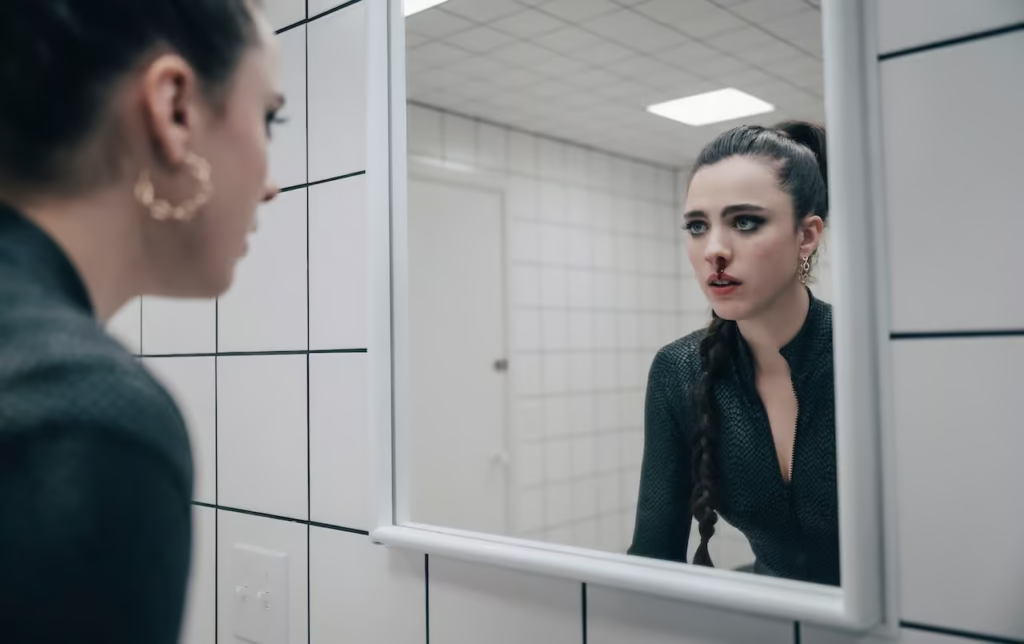
Sue believes that she’s won. But victory, it turns out, in this case requires maintenance.
Without Elisabeth, Sue loses access to the stabilizing fluid that kept her perfect. Her solution? Overdose. More serum, more enhancement, and more of the thing that already broke the rules.
Instead of preserving herself, Sue accelerates the decay.
This is the moment the ending of The Substance shifts from tragedy into satire. Sue isn’t destroyed by aging; she’s destroyed by optimization. Her body begins to mutate, stitching Elisabeth back into her in grotesque ways.
Perfection doesn’t vanish; it mutates.
The New Year’s Eve Meltdown: When Glamour Bleeds
The climax unfolds live on television.
Sue hosts a glittering New Year’s Eve broadcast, which is the ultimate symbol of cultural relevance. Under studio lights and screaming crows, her body starts betraying her.
Skin splits, limbs distort, and face overlaps. Sue becomes a hybrid, part Elisabeth, part Sue, and part nightmare. The camera doesn’t cut away, and the audience doesn’t flee.
They watch. This is the most savage beat in The Substance ending, even as the illusion collapses, consumption continues. The spectacle doesn’t end because the product failed, it ends because it physically can’t hold together anymore.
Hollywood doesn’t reject the monster. It applauds it.
The Final Image: Not Rebirth, But Ruin

There is no redemption in The Substance ending.
No survivor limps into the sunrise. No lesson is neatly spelled out. Elisabeth and Sue fuse, but not into wholeness, into wreckage. Beauty and decay become indistinguishable.
The final body is not a punishment. It’s a receipt.
Every compromise. Every shortcut. Every lie sold as empowerment is visible in the flesh. This is what happens when self-improvement forgets self-preservation.
What The Substance Ending is Really Saying (And Why It Hurts)
Strip away the blood and prosthetics, and The Substance ending is painfully familiar.
It’s about hustle culture dressed as wellness. It’s about industries that reward women for disappearing gracefully. It’s about the lie that reinvention must involve erasure.
Elizabeth isn’t punished for vanity. She’s destroyed by a system that taught her that relevance was temporary. Sue isn’t punished for ambition. She’s destroyed by believing that growth has no limits.
The horror isn’t a transformation. The horror is replacement.
Also, read The Woman in the Yard Ending Explained: What Really Happened Beneath the Lawn
Coralie Fargeat’s Sharpest Cut Yet
Coralie Fargeat doesn’t moralize. She dissects. The Substance ending works because it refuses comfort. It doesn’t tell you to love yourself. It shows you what happens when self-love is conditional.
This is body horror as cultural critique. Face as cannibalism. Youth as currency. Empowerment as a marketing slogan that forgets the human cost.
There’s no tidy takeaway. Just a question that lingers long after the blood dries: If becoming perfect means killing parts of yourself to get there, who exactly are you trying to save?
Frequently Asked Questions
1. What happens at the end of The Substance?
In The Substance ending, Elisabeth and her clone Sue violently merge during a final confrontation. The fusion leaves a scarred, imperfect Elisabeth who survives, but loses her former beauty.
2. What does the new Elisabeth represent?
She symbolizes self-acceptance and the rejection of perfection. The scars show that chasing an impossible ideal only destroys what was already whole.
3. Is Sue really dead in The Substance ending?
Technically, no. The two merge into one being, meaning Sue’s essence survives inside Elisabeth. It’s both haunting and poetic they can never be separated again.
4. What is the message behind The Substance ending?
The film critiques society’s obsession with youth, beauty, and reinvention. The Substance ending warns that perfection is not empowerment, it’s erasure.