Most creature features train you to pick sides early. There’s the monster, and then there are the humans running for their lives. Primate refuses to make that choice an easy one. Directed by Johannes Roberts, this tense natural-horror film takes a premise that sounds almost absurd: a family pet chimpanzee turning violent and slowly transforming it into something far more upsetting. Not because of gore (though there’s plenty), but because of recognition.
This is not a movie about a wild beast invading domestic space. It’s about a family that invited the wild inside, dressed it up as love, and ignored every warning sign along the way. Set largely within a single luxury home during a disastrous pool party, Primate builds dread through intimacy. With the Primate ending, the film strips away spectacle and leaves us with something rawer. Grief, responsibility, and the cost of pretending nature can be trained out of itself.
⚠️Spoiler Alert: This breakdown dives straight into the heart of Primate (2026), revealing Ben’s fate, the rabies twist, and who makes it out alive. If you haven’t watched the film yet, now’s the moment to turn back; the Primate ending only lands when you experience it unspoiled.
The Setup: A Family, a Vacation, and a Dangerous Normal
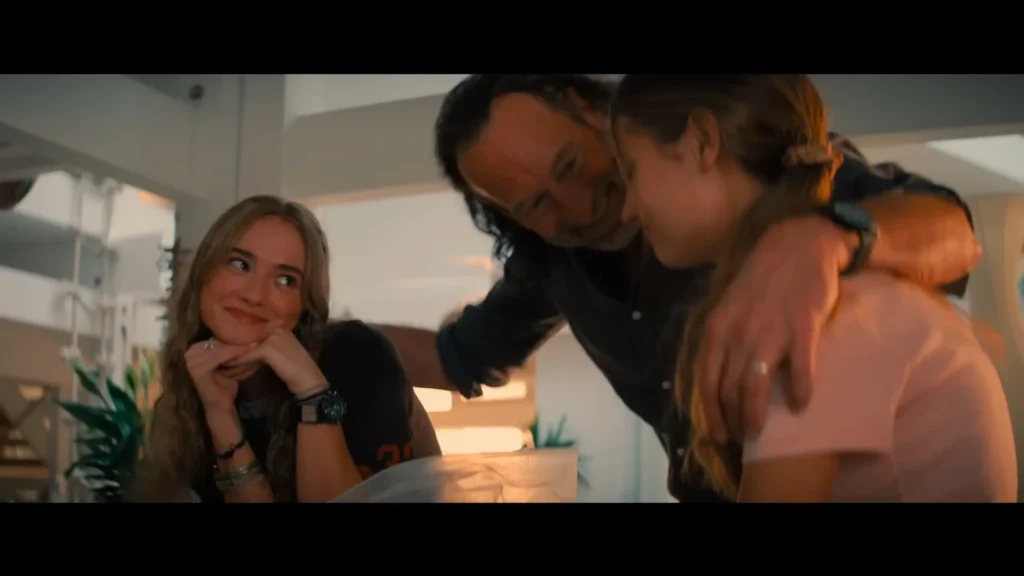
The film opens like a sun-soaked drama. Adam, his daughter Lucy, Erin, and their extended family are vacationing at a tropical estate. Everything feels indulgent, a little careless, and very comfortable. At the center of it all is Ben, a chimpanzee who has been raised as part of the family since infancy.
Ben eats with them, plays with them, and understands commands. He’s been humanized to the point where the family barely sees him as an animal anymore.
That illusion shatters when Ben escapes his enclosure and kills Lambert, his handler. The death is quick, brutal, and immediately brushed aside by the family as an accident. What they don’t know and what the audience soon learns is that Ben was bitten by a rabid mongoose earlier that day.
The infection has already begun.
Chaos at the Pool Party
The bulk of Primate unfolds over one night during a large pool party attended by friends, teens, and random guests. Alcohol flows, boundaries blur, and then disappear. Warnings go unheeded. Ben reappears.
What follows is less a rampage and more a series of horrifying interruptions. People vanish, screams cut through music, and bodies are discovered in pieces. Ben isn’t stalking strangers in the woods; he’s tearing through a space that once felt safe.
Victims include Nick, pulled from a cliff edge. Kate, crushed by falling rocks. Hannah, mistaken for someone else and killed while trying to escape. Drew and Brad, brutally mauled while attempting to fight back.
Each death reinforces the same idea: isolation equals death. The people who survive are the ones who stay together.
Which brings us closer to the ending of Primate.
The Twist That Changes Everything: This Wasn’t Madness
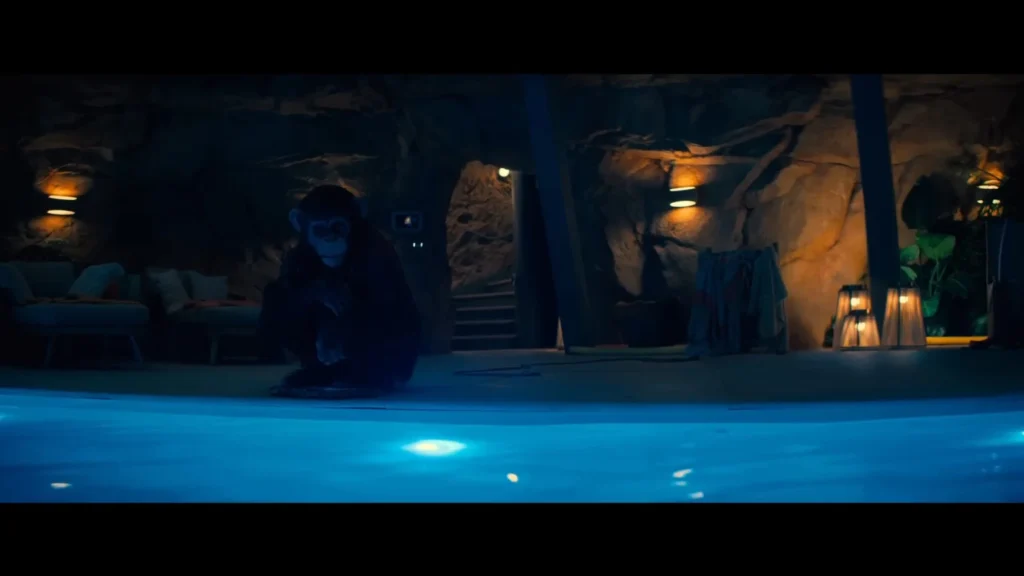
Midway through the film, a crucial detail emerges. A lab text, missed and dismissed, delivers the devastating confirmation that Ben has rabies. This revelation reframes everything. Ben isn’t evil or snapping. He isn’t acting out of betrayal or jealousy. He’s sick.
Rabies strips away inhibition, heightens aggression, and destroys the nervous system. Ben’s violence isn’t calculated; it’s biological. A tragic inevitability set in motion by human negligence. The film makes this painfully clear through haunting details. Ben uses a tablet to scribble fragmented phrases, including “Luch bad”. It’s unclear whether this is blame, confusion, or the last flicker of cognition before total collapse.
The Primate ending hinges on this ambiguity. Ben is both a victim and a threat.
The Family’s Reckoning
As the body count rises, the remaining family members, Lucy, Erin, and their father, Adam, are forced into action. Gone is the fantasy of control. Gone is the idea that love can override instinct.
They don’t fight Ben with weapons or bravado. They exhaust him, distract him. They work together. This matters.
Throughout the film, strangers and outsiders die quickly. The family survives not because they’re stronger, but because they stay connected. Lucy repeatedly puts herself in danger to protect Erin. Adam stops trying to “fix” the situation and starts responding to it.
The Primate movie ending cannot be separated from this shift. Survival comes not from dominance over nature, but from accepting its limits.
The Final Confrontation: No Victory, Only Endurance
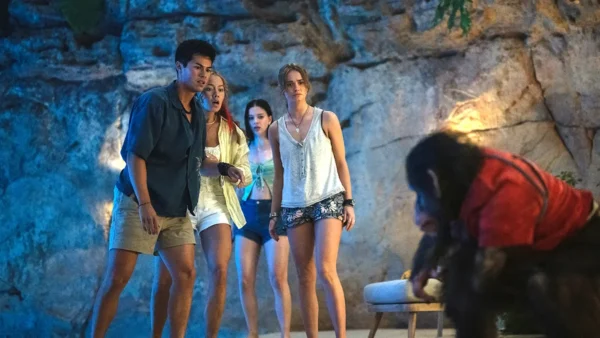
In the final act, Ben is dehydrated, injured, and barely functioning. He charges one last time near the pool.
There’s no dramatic showdown. No heroic kill. Ben impales himself on broken poolside furniture, his own momentum sealing his fate. It’s sudden, awkward, and tragic.
He collapses, the family survives, and that’s it.
The Primate movie ending doesn’t linger on triumph. There’s no cathartic release, no applause for survival. Just shock, exhaustion, and the unbearable quiet that follows irreversible damage.
What The Primate Ending Really Means
The Primate ending works because it refuses to turn tragedy into spectacle. Ben doesn’t die as a villain. He dies as a consequence. This is a film about domestication as hubris.
Ben was never meant to be a pet. The enclosure was never enough. The family’s love was never protection.
By treating Ben as human, they denied his nature and, in doing so, ensured the outcome they feared most.
The ending of Primate suggests something deeply uncomfortable. The line between care and control is thinner than we like to believe.
Why This Isn’t a “Monster Movie”
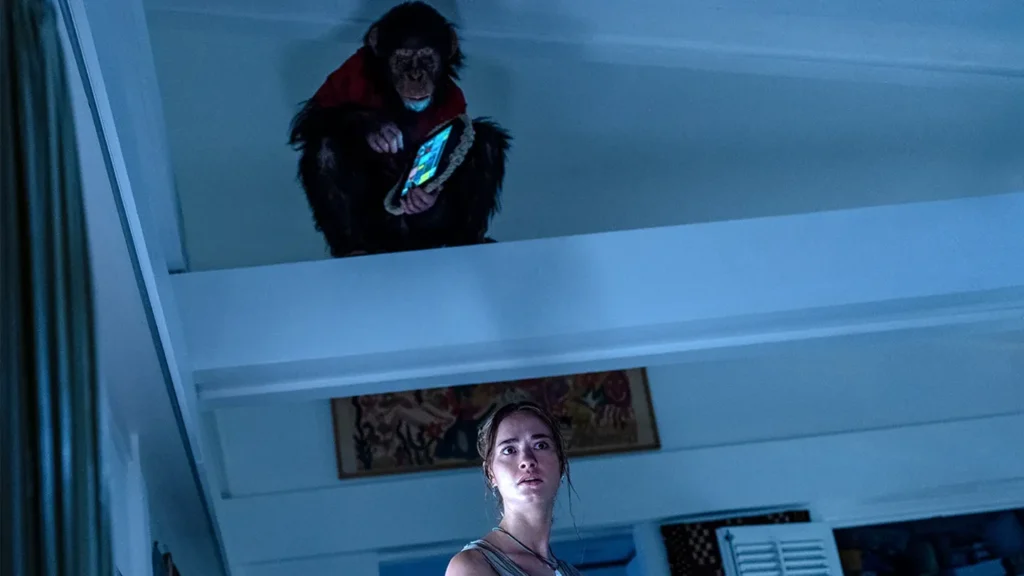
It’s tempting to categorize Primate alongside other animal-attack films. But that misses the point. Ben isn’t invading human space. Humans invaded his.
The Primate movie ending reveals the real antagonist isn’t the chimpanzee, it’s the assumption that affection equals ownership. That intelligence equals safety. That wildness can be edited out of biology.
This isn’t about nature turning on humanity. It’s about humanity refusing to listen.
The Survivors Aren’t “Safe”
Lucy, Erin, and Adam survive. But the film makes it clear that survival is not recovery. They’ve lost friends, family, and a being they once loved.
There’s no epilogue promising healing, no lawsuit subplot. No moral cleanup.
The Primate ending leaves them alive, but permanently changed. And that feels more honest than any neat resolution.
Final Thoughts: A Tragedy, Not a Warning
The Primate ending hits hard because it doesn’t shout its message. It lets you sit with it. This isn’t a cautionary tale about rabies alone. It’s about boundaries, ethical, biological, and emotional. About the danger of projecting human needs onto non-human lives.
Ben was loved, cared for, and doomed anyway.
Primate doesn’t ask us to fear animals. It asks us to fear our confidence that we understand them.
And that quiet, devastating realization is what lingers and stays with us long after the credits roll.
More Endings Worth Decoding
- Kingdom of the Planet of the Apes Ending Explained: Hope, Betrayal, and a New War
- When Evil Lurks Ending Explained: Evil Wins, and It’s Not Even Close
- Cobweb Ending Explained: What Lurks Behind the Wall
Frequently Asked Questions
1. Is Ben really dead at the end of Primate?
Yes. The Primate ending confirms Ben dies after impaling himself during his final charge. There’s no hint of survival or recovery.
2. Was Ben evil or just sick?
Ben was infected with rabies, which explains his aggression and loss of control. The film strongly frames him as a tragic figure rather than a villain.
3. Why do Lucy, Erin, and Adam survive?
They survive because they stay together and adapt, rather than trying to dominate or isolate the threat. Unity, not strength, is what saves them.
4. What is the main message of Primate?
The film explores the consequences of blurring the line between domestication and the denial of nature. Love doesn’t erase biology, and pretending otherwise can be fatal.