Most movies chase noise. Kumiko, The Treasure Hunter, chases a feeling. This 2014 indie centers on a woman who believes a film holds a secret treasure, turning a VHS tape into her personal destiny. Her odd, almost charming quest starts like a fairytale, but step by step, it becomes something far more haunting, intimate, and heartbreakingly human.
At its core, the film is about a woman who refuses to accept the life handed to her. She trades fluorescent office lights for snowstorms, loneliness for adventure, and reality for a dream that may never have existed at all. Kumiko, The Treasure Hunter ending leaves viewers torn between hope and heartbreak, unsure whether Kumiko truly finds what she seeks or simply finds peace.
In this article, we’ll break down the ending of Kumiko, The Treasure Hunter, explore what really happens in the final moments, revisit her surreal journey, and unpack why this strange little film continues to linger long after the credits roll.
Who is Kumiko?
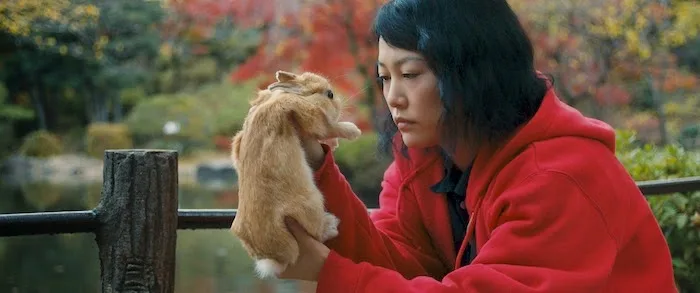
Kumko is not a hero, nor is she a rebel. She is just tired. She works in a dull office in Tokyo, watching her job slowly slip away to a younger colleague. Her mother pressures her to marry. Her boss barely notices her. Even her only friend, Sakata, drifts out of her life.
Her world is quiet, gray, and predictable.
And then she finds something that changes everything, a worn VHS tape of Fargo.
Where everyone else sees fiction, Kumino sees a message. A map, a promise. She becomes convinced that the ransom money buried in Fargo is real and waiting for her in Minnesota.
And just like that, her ordinary life cracks open!
The Map, the Myth, and the Mission
Kumiko pauses the VHS frame by frame, tracing the snowy fencepost, the briefcase, and the path. She photocopies the cover and tapes together her own treasure map.
This is where fantasy begins blending with reality.
She steals her boss’s credit card, abandons her pet rabbit, Bunzo, at a shrine. She boards a flight to the United States without knowing English, without a plan, without fear!
The world tries to stop her, but she keeps walking.
This whole process of slowly unraveling the reality is what makes the Kumiko, The Treasure Hunter ending resonating to some. It’s not about the treasure, it’s about unleashing the boredom, the monotony, the routine. It’s about escaping!
America Through Kumiko’s Eyes
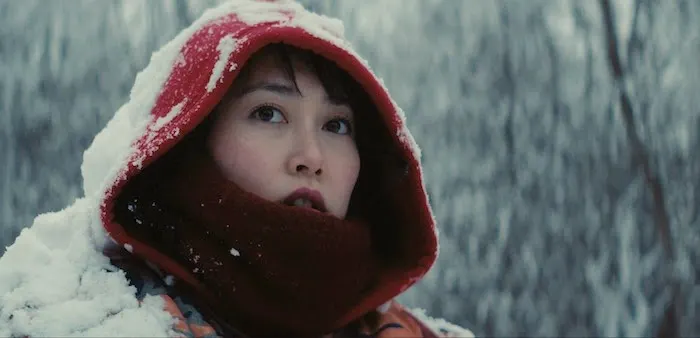
Minnesota is not welcoming. Snow swallows roads, people misunderstand her. Though Police Officer Ken tries to help her, offering maps and food. His family welcomes her briefly. She kisses him, unaware that he is married, which serves as a reminder that she is always out of place.
Her money runs out, her credit card stops working, and her mother disowns her over a phone call.
Still, Kumiko walks and continues. Taxi drivers drop her off in the middle of nowhere. A deaf driver abandons her in a blizzard. And yet, she pushes forward.
Because she believes the treasure must be real.
It has to be!
Also, read Woman in Cabin 10 Ending Explained: The Twist, the Truth, and Lo’s Final Escape
The Final Moments: What Really Happens?
Kumiko drags herself across the endless white, her breath breaking into tiny clouds as the cold seeps into her bones. The world feels unreal now. It’s all silent, weightless and frozen in time. And then she sees it, the fencepost from Fargo, standing exactly where she believed it would be.
With shaking hands, she drops to her knees and begins to dig. Snow pours into her sleeves, her fingers burn, her strength fades, yet she keeps going, driven by a promise only she can see. Every movement feels like a final act of faith, a refusal to let the dream die in the cold.
When the case finally opens, there’s money inside. Kumiko smiles, whispering, “I was right”. Bunzo appears beside her, soft and familiar, and together they walk into the white horizon. The world dissolves around them as the screen fades, sealing the ending of Kumiko, The Treasure Hunter in quiet mystery and emotional wonder.
Was the Treasure Real in Kumiko, The Treasure Hunter Ending?
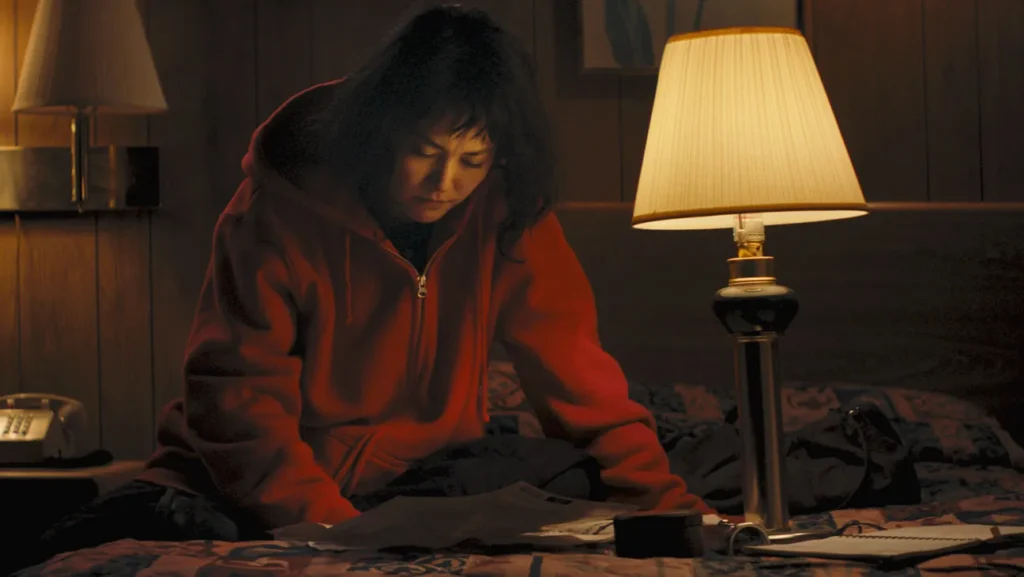
Most likely no; the treasure shown in Kumiko, The Treasure Hunter ending was never real. Many viewers see the final moments as a hallucination brought on by cold, exhaustion, and isolation. The money, Bunzo, the walk into the horizon, these are not literal rewards, but the emotional ones. They are the mind’s last gift, like a soft landing when the world has been too heavy to carry. And yet, the film refuses to close the door completely. It never confirms what is real and what is imagined. That choice matters.
By leaving the truth unresolved, the story allows Kumiko her victory. She does not need reality’s permission to feel fulfilled. And that is why the ending of Kumiko, The Treasure Hunter feels so quietly powerful, because it lets belief become its own kind of truth.
Themes Hidden Beneath the Snow
The story is driven by the power of belief. Kumiko’s faith in the treasure gives her direction, something her real life never did. Even if the map is only a fantasy, it fuels her courage and keeps her moving forward. Her journey also becomes an escape from a life that feels invisible and suffocating. The endless routines, quiet loneliness, and constant pressure to fit in slowly fade as she steps into her own adventure.
Finally, the film shows how myth can become a form of survival. When reality offered no space for hope, Kumiko created her own. That is why the Kumiko, The Treasure Hunter ending does not feel tragic; it feels like a fragile, bittersweet kind of victory.
Also, read Hedda Ending Explained: Beauty, Control, and the Art of Ruin
Final Thoughts on Kumiko, The Treasure Hunter Ending
The Kumiko, The Treasure Hunter ending is not a story about fortune or discovery; it is a story about anticipation and longing. It speaks to that quiet part of us that wants to believe life holds something more than routine and disappointment. Kumiko’s journey is painful, strange, and deeply moving because it mirrors a truth many people carry but rarely admit: the need to chase meaning, even when the world offers none. Whether the treasure exists or not is beside the point. What matters is that Kumiko finally feels alive, seen, and driven by something greater than fear.
She chooses hope over certainty, imagination over survival. In doing so, she claims a freedom she never had before. Her final steps are not toward wealth, but toward belief itself, an act of courage that lingers long after the screen fades.
Frequently Asked Questions
1. Did Kumiko really find the treasure at the end?
The film leaves it ambiguous. Most viewers believe it is a hallucination.
2. Why does Bunzo appear at the end?
He symbolizes comfort, innocence, and peace.
3. Is Kumiko, the Treasure Hunter a true story?
Kumiko, the Treasure Hunter is loosely inspired by a real woman who believed Fargo was real.
4. What does Kumiko, the Treasure Hunter ending mean?
It shows how belief can be a form of survival, even when reality fails.