Certain twists shove you in the ribs; this one humbly redesigns the room you’re sitting in. The Sixth Sense proceeds like a sorrowful ghost tale snuck into a family drama, a cold parable of mourning and the ways we communicate (or don’t) go beyond the barriers we construct. What keeps The Sixth Sense ending stuck with us isn’t merely the light-switch moment of revelation but rather the degree to which the film retrofits all preceding scenes with searing understanding. You don’t rewatch it to look for tricks; you rewatch it to see the glances that you missed.
Oscar-nominated M. Night Shyamalan weaves terror through quotidian settings: kitchens, church hallways, no-frills Philly streets. The atmosphere is winter-bright and hush-quiet, led by James Newton Howard’s score and those restrained, observant performances. And then the last few minutes fall into place, transforming a scary setup into a softer narrative of devotion, unresolved business, and hearing an understated design move that renders The Sixth Sense ending both inevitable and magnanimous at once.
⚠️ Spoiler Warning: Read only if you’ve seen The Sixth Sense or don’t mind knowing the ends.
Quick Premise Refresher
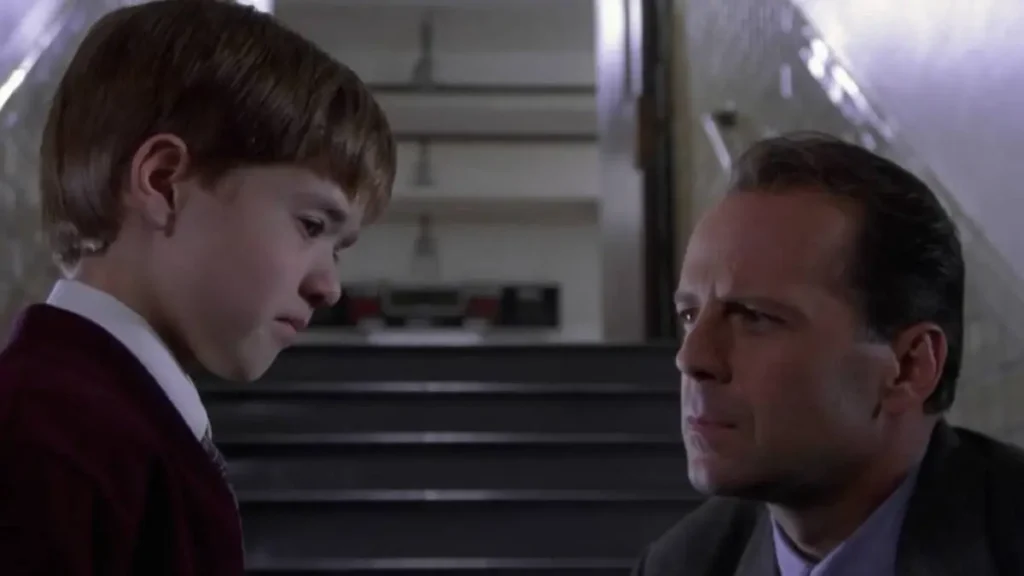
Philadelphia, late ’90s. Child psychologist Dr. Malcolm Crowe (played by Bruce Willis, an action hero acting exquisitely against type) has a new client: Cole Sear (played by Haley Joel Osment, an Oscar nominee), a fearful boy apparently afraid of the invisible. The narrative sets it up as a redemption path where Malcolm’s attempt to do good after one of his patients, Vincent Grey (Played by Donnie Wahlberg in a striking, violent cameo), breaks his spirit.
At home, Malcolm’s marriage is cooling. Anna Crowe (Olivia Williams) drifts through dinners and anniversaries like a sleepwalker, and Malcolm can’t seem to bridge the distance. Meanwhile Cole’s single mom, Lynn Sear (Toni Collette, an Oscar nominee), juggles shifts and worries, convinced something is wrong even if she can’t name it. The premise sets two wounded families on parallel tracks toward The Sixth Sense ending, where secrets finally have to be said out loud.
The Final Sequence
Let’s discuss and talk about what literally happens.
Cole Tells The Truth
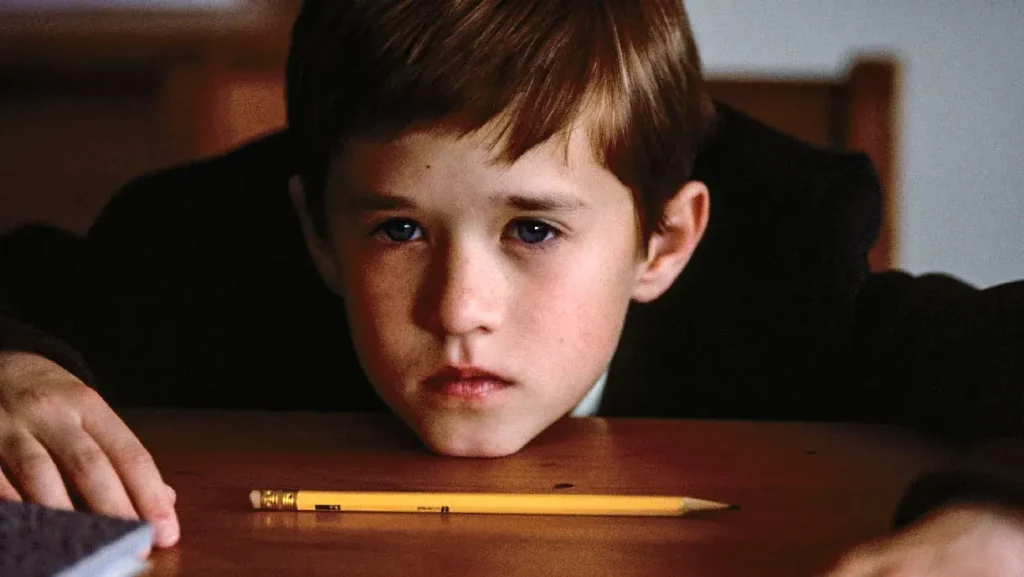
In a car stalled by traffic, Cole finally tells Lynn the secret that’s been eating him alive: “I see dead people.” He proves it by sharing a private message from his late grandmother, something Lynn asked at the graveside that no one else could know. The air changes. Lynn’s face breaks in a way that reads as relief and sorrow at once. She believes him. That belief is the first real exorcism the film offers.
Malcolm comes home to discover Anna dozing off in front of their anniversary tape. The mood is somber, thick with emptiness. She wakes, and his ring drops out of her hand onto the floor. He stares at his hand. No ring. The room reverses itself in his thoughts: evenings at which no one spoke with him, chill restaurant “dates” that were anniversary parties, doors that failed to open. He grips his side and then there it is the gunshot wound that was inflicted upon him by Vincent at the prologue. Malcolm is dead. He has been dead all along.
Malcolm Sees What’s Missing
Assuming this, Malcolm kneels beside Anna and says what he couldn’t while he lived: she was “never second.” The room’s temperature seems to stabilize. Breath unmist. The wedding tape flickers on their best day, and he releases. The screen blurs to white. The Sixth Sense ending becomes less about trickery and more about license to mourn, move forward, utter the thing that’s most significant before the curtain opens.
A Goodbye That Lands
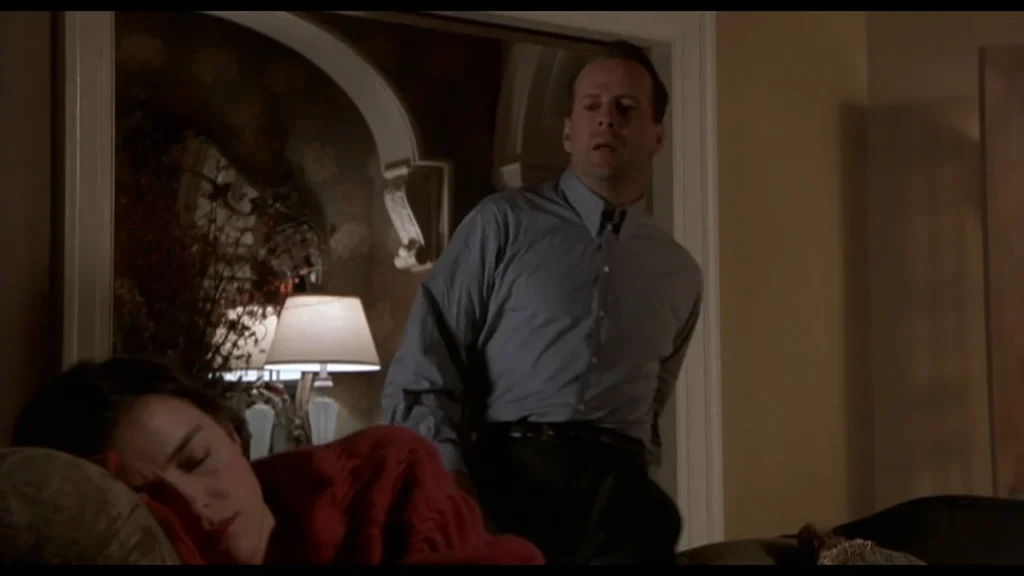
Following this, Malcolm kneels beside Anna and says what he couldn’t while living: she was “never second.” The room’s temperature finds equilibrium. Breath unfogs. The wedding tape flutters on their happiest of days, and he releases. The screen blurs to white. The ending of The Sixth Sense becomes less about gimmick and more about license to mourn, to get on with one’s life, to utter the thing that’s essential before the curtain opens.
Also, read Wall to Wall Ending Explained: Noise, Neighbors and the Price of a Dream
What The Sixth Sense Ending Really Means
Before labeling reads, time how meticulously the film educates you about its rules. Red marks boundaries (a doorknob, a balloon, a church blanket). Cold rooms signal company. Conversations are “one-sided” because they are. Knowing such rules, The Sixth Sense ending follows like the solution to an equation the movie taught you how to construct.
A Ghost Story About Marriage
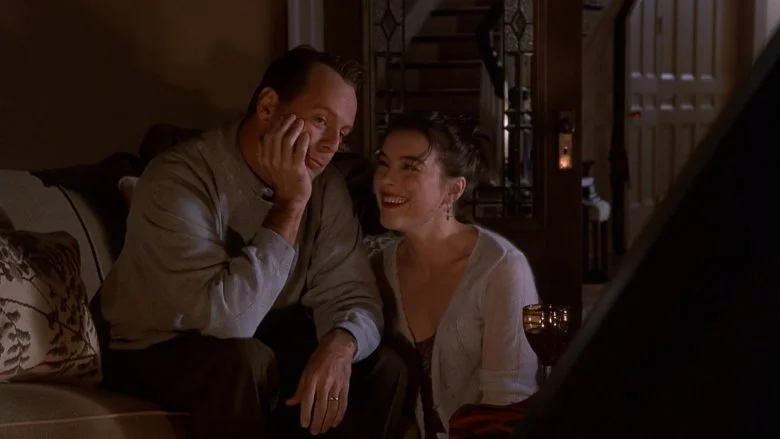
The twist redesigns the film as a marriage drama from the wrong side of the veil. Malcolm continues “showing up” to apologize, but he isn’t even present in the room, thus the mute dinner, the static-rich anniversaries, the fact Anna never looks at him while she “answers.” The clinking of the wedding ring is the minimal sound of the film and the noisiest concept: attention is love, and he missed it until it was gone. The Sixth Sense ending is an elegy for the talks we put off.
Therapy, Inverted
Malcolm assumes he’s the healer; Cole fixes him up. Their last sessions move from “healing” Cole to listening, trusting, and treating the dead nicely—assisting them with what’s holding them back. That empathy frees up Malcolm’s own unresolved issues. The Sixth Sense ending suggests the patient’s reality restores the doctor’s denial, a nice reversal that supports each second of the last minutes.
Seeing as Caring
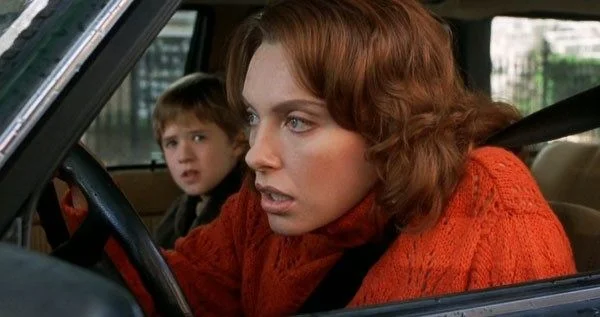
Cole’s gift is no spectacle but rather responsibility. The car confession with Lynn is the moral epicenter of the film, she believes, he’s believed, and the family ceases gaslighting itself out of devotion. That’s why the conclusion warms as it reveals; the horror vocabulary yields domestic vocabulary. The Sixth Sense ending demands that “I see dead people” is instead “I see your pain,” and seeing constitutes the first kindness.
Rules of the Red
Shyamalan embeds the supernatural with red touches—the doorknob that Malcolm cannot open, the balloon that floats toward the stairwell, the blanket that lies across the pew. The ring (a circle, a promise) in the ending becomes the significant red item by negation. When it falls, the color logic makes sense: doorsills aren’t gates; they’re memories. The door was not locked; he was.
Also, read Heretic Ending Explained: Faith, Fear and One Seriously Twisted Garden
Closing Thoughts
Even through all the parodies, the twist still works because it’s not out to deceive, but rather, it encourages you to see the entire narrative with gentle eyes. The ending of The Sixth Sense exchanges the magician’s gesture with a subtle reset. What previously frightened Cole becomes something that he can bear. What has bewildered Malcolm comes into view due to one small void, an absent circle of gold.
Now picture the ring hitting the floor with one clean tap and think about the everyday ways we miss each other. The film argues for small heroics: pay attention, believe the people you love, let them finish the sentence. The Sixth Sense Ending doesn’t wink; it exhales.
Frequently Asked Questions
1. Was Malcolm dead the whole time?
Yes. The opening gunshot kills him, and everything after tracks a ghost trying to finish his last task. The film hides this by staging scenes so he never truly interacts with anyone but Cole—The Sixth Sense Ending just makes the staging undeniable.
2. Why can Cole see him when others can’t?
Cole’s ability lets him see the dead who “don’t know they’re dead.” He can speak with them, help them complete what they need, and send them on. That’s why The Sixth Sense Ending is less a trick and more a transfer of purpose.
3. What’s the significance of the red objects?
Red flags thresholds—places where the worlds almost touch. The basement doorknob, the drifting balloon, small wardrobe accents—they quietly cue you. In the finale, the wedding ring’s absence delivers the last, crucial red “signal.”