Cosmic Princess Kaguya ending is the kind that arrives softly and then stays forever with you. On the surface, it looks like a colorful, near-future anime about VR idols, moon legends, and viral music battles in Tokyo. But beneath the neon lights and hologram stages, it’s a quiet story about memory, waiting, and choosing your own ending, even when the universe insists otherwise.
Netflix’s 2026 anime film reimagines The Tale of the Bamboo Cutter for a digital age, blending folklore with sci-fi and emotional storytelling. At the heart of it are two girls, Iroha Sakayori, a struggling teen songwriter, and Kaguya, the mysterious “sister” raised beside her, who is secretly not from Earth at all. Their bond becomes the emotional engine of the film, pulling the past, present, and future into a single fragile thread.
The Cosmic Princess Kaguya ending doesn’t go for tragedy. Instead, it asks a bold question: what if destiny could be rewritten, not with violence, but with music, memory, and stubborn hope?
⚠️ Spoiler Alert: This article discusses the ending of Cosmic Princess Kaguya. If you haven’t watched the film yet, consider pausing here, because once you know how the ending unfolds, there’s no un-seeing it.
Recap: A Folktale Reborn in Neon
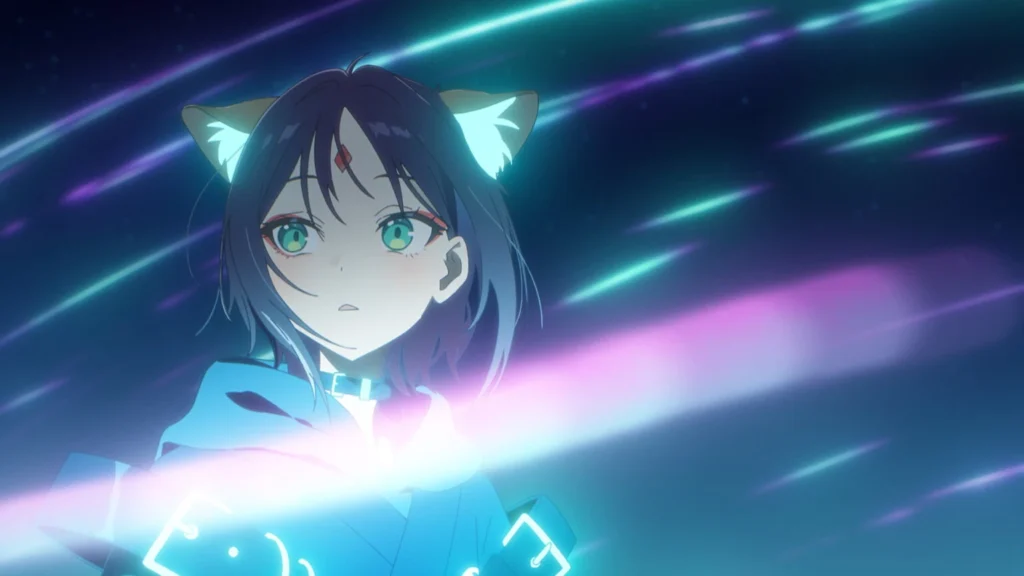
Iroha Sakayori grows up believing she has an older sister named Kaguya. Their life feels ordinary: the messy apartments, cheap noodles, late-night music sessions. But everything changes when Iroha learns the truth — Kaguya was found as a glowing infant inside a bamboo stalk. Not metaphorically, literally.
Thousands of years ago, a small lunar spacecraft crashed into Earth. Inside it was Kaguya. She was discovered by a loyal, dog-like AI guardian called InuDoge, who preserved her in stasis. When Earth’s technology finally advanced enough, InuDoge awakened her and placed her into a synthetic childhood, creating a new life so she could grow up like a human.
To protect her, InuDoge built a massive virtual world called Tsukuyomi, where Kaguya could exist safely as the idol “Yachiyo”. In this digital world, Kaguya becomes famous, adored by millions who don’t realize she’s not human at all.
Meanwhile, Iroha struggles to find her voice as a musician. She joins an underground VT music crew called Black OnyX, battling rival artists through emotional, immersive performances. Their songs are not just entertainment; they are data streams that affect the Tsukuyomi system itself.
Everything seems stable until the Moon Enforcers, cold, ancient beings who created Kaguya, return. They want her back. To them, Earth is temporary. Humanity is noise. Kaguya was never meant to stay.
The Hidden Truth Behind Kaguya’s Identity
As the story unfolds, the film reveals that Kaguya has been repeating this cycle for millennia. Each time she grows close to humans, her memory is erased, and she is pulled back into Tsukuyomi.
The shocking twist? Iroha is the constant. Across timelines, versions of Iroha have always existed, drawn to Kaguya through fate. InuDoge preserved traces of these loops, hiding them deep in the system.
Kaguya herself created the Tsukuyomi idol Yachiyo as a backup version of her soul, an echo designed to wait for Iroha. She didn’t just want to live. She wanted to remember.
This makes the Cosmic Princess Kaguya ending less about escape and more about breaking a cycle that no one else even realizes exists.
The Final Act: Music as a Weapon Against Fate
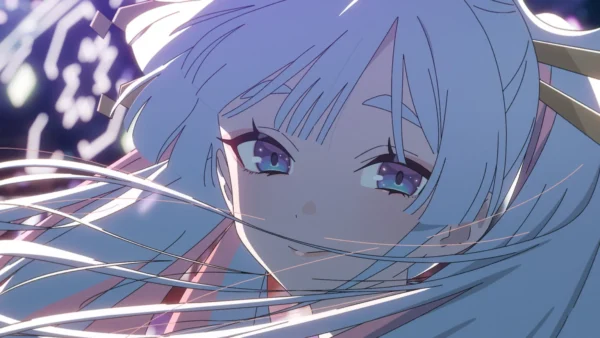
The Moon Enforcers begin deleting Kaguya’s emotional data. Her memories of Iroha fade. Their childhood disappears from her mind in real time.
Iroha refuses to let her go. She uploads her unfinished song, which is written for Kaguya, into the Tsukuyomi core. But instead of finishing it, she leaves it broken, incomplete. The system can’t process the emotional contradiction. That glitch cracks the lunar control program.
Kaguya suddenly remembers everything.
She remembers the bamboo, the centuries, the loneliness, and most importantly, Iroha.
This moment is the emotional heartbreak of the Cosmic Princess Kaguya ending. It’s not loud, it’s not violent. It’s simply two people choosing to see each other again.
Also, read Death Note Ending Explained: Warehouse Showdowns, Shinigami Shenanigans and One Very Doomed Genius
Ten Years Later: A New Kind of Miracle
The Moon Enforcers retreat, but Kaguya’s physical body begins to fail. She was never built for Earth’s gravity or time.
Iroha spends the next ten years creating something impossible: a synthetic body that can hold Kaguya’s consciousness permanently. She collaborated with Black OnyX, InuDoge, and underground tech communities.
Finally, during a massive VR concert, Iroha sings her completed song, titled “Ray”.
The stage fills with light. Kaguya appears, not as an illusion, not as an idol, but as herself. In a new, artificial body. Alive, free, and human.
They perform together. The crowd believes it’s special effects. But Iroha knows the truth. Kaguya is finally staying. This is the triumph of the ending of Cosmic Princess Kaguya, where love and technology rewrite a myth that always ended in loss.
Why The Cosmic Princess Kaguya Ending Hits So Hard
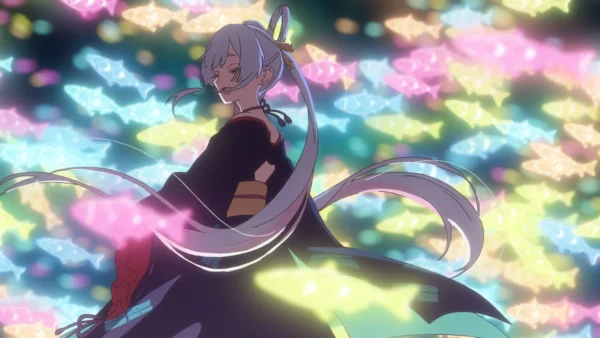
The original Bamboo Cutter legend ends with Kaguya returning to the Moon, leaving heartbreak behind. This film refuses that narrative.
Instead, it asks What if the tragedy was never necessary? What if love could be saved, not by magic, but by effort, patience, and belief?
The Cosmic Princess Kaguya ending is hopeful without being naive. It acknowledges pain, time, and sacrifice, but insists they don’t have to define the future.
Kaguya doesn’t escape her fate; she changes it.
Final Thoughts: A Love That Refused to End
The Cosmic Princess Kaguya ending doesn’t try to be clever. It tries to be honest. It tells us that some bonds feel bigger than time, deeper than memory, and stranger than a system designed to erase them.
Iroha doesn’t save the world. She saves one person. And in doing so, she saves herself, too.
In a universe obsessed with control, this story chooses connection. In a myth built on goodbye, it dares to say stay.
And that is why the ending of Cosmic Princess Kaguya feels like more than a film; it feels like a promise.
More Ending Worth Decoding
- Gantz: 0 Ending Explained | Is Kato Trapped in an Endless Game of Death and Resurrection?
- K-pop Demon Hunters Ending Explained: Sacrifice, Stages, and Supernatural Showdowns
- Marvel Zombies Ending Explained: When Heroes Become The Universe’s Worst Buffet
Frequently Asked Questions
1. Is the Cosmic Princess Kaguya ending a happy one?
Cosmic Princess Kaguya ending is hopeful, not easy. Kaguya doesn’t return to the Moon, and Iroha doesn’t lose her. Their bond survives through time, memory, and technology, making it an emotional victory rather than a tragedy.
2. Why does Iroha leave her song unfinished?
The incomplete song acts as a glitch, an emotional paradox the system cannot erase. It forces Kaguya’s memories to resurface. This is the turning point of the Cosmic Princess Kaguya ending.
3. Is Yachiyo the same as Kaguya?
Yachiyo is an AI version created by Kaguya herself, a preserved fragment of her soul. She exists as a bridge between past loops and the final timeline that leads to the Cosmic Princess Kaguya ending.
4. Does the story imply time travel?
Yes, but emotionally rather than mechanically. Memories, loops, and preserved consciousness create a form of time stasis, allowing love to repeat until it finally succeeds.